Curriculum drift is the one readiness measure a Dean can act on
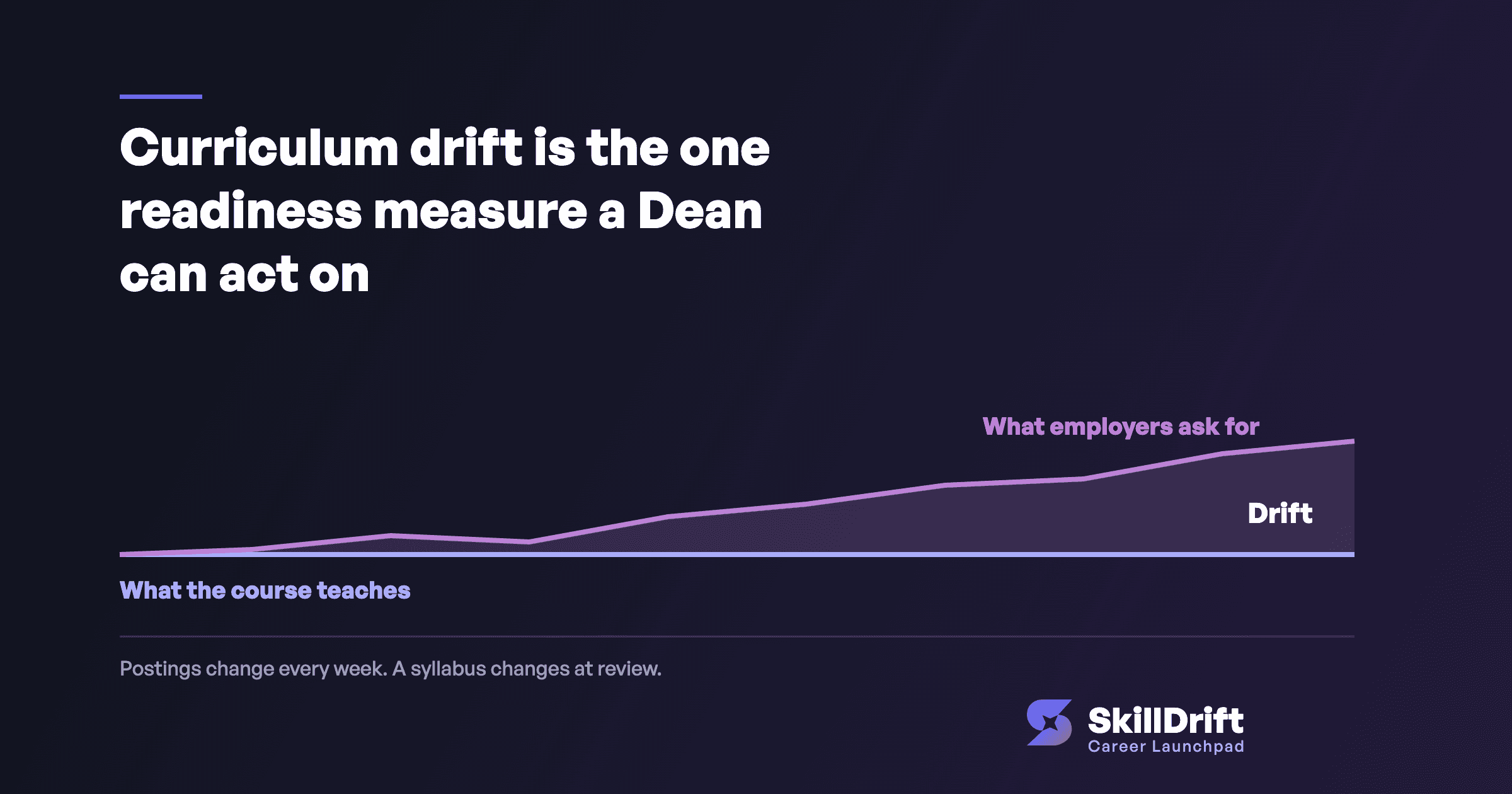
Curriculum drift measures how far a department's courses have moved from what employers ask for. Why it is a Dean's number, and what to do this term.
Most readiness numbers describe students. A Dean cannot change a student. A Dean can change a course.
So a Dean needs a different number. It answers one question: which of our courses has drifted furthest from what employers ask for?
That number is curriculum drift. Here is what it measures, why it moves, and what a Dean and a career centre can do with it this term.
1. What is curriculum drift?
It is the distance between what a department teaches and what employers in its market ask for.
A syllabus stays still between reviews. Job postings change every week. The gap that opens between the two is drift.
2. How fast does the market move?
It moves faster than any review cycle.
In the job postings we index, SQL rose from 10.5 to 13.0 percent of postings between August 30th and October 4th. Python rose from 13.7 to 16.2 percent. Both are seven day averages, and both moves took five weeks.
Other asks hardly move at all. In our October hiring pulse, about half of entry level postings asked for communication: 50 percent in Singapore and 52 percent in US degree roles. That share has not changed since June.
So drift has two sources. Some skills move in weeks. Others stay put, but no department owns them.
3. Why is this a Dean's question?
A career centre works with students. It can coach, refer and prepare them. It cannot add a module or change an assessment.
A Dean can. A Dean can add a project, change what a course assesses, or bring an employer into a module.
Curriculum drift points at those levers. That is why it belongs on a Dean's desk.
4. How is drift measured?
It sets each department's courses beside the skills employers in that department's market ask for in live postings.
Where the two are furthest apart, drift is largest.
In SkillDrift Career Launchpad, curriculum drift shows which departments are teaching away from what employers are hiring for, quantified per course. It sits beside the employer demand pulse, which shows the functions hiring, the sectors pulling and the skills each department's market asks for. That demand data is captured continuously, for the market your institution sets.
5. What does drift not tell you?
It does not tell you a course is bad.
Some courses teach foundations that employers never write into a posting. A theory course can show high drift and still be essential.
Drift tells you where to look first. The decision about the course stays with the faculty.
6. What can a Dean or career centre do this term?
Four things, starting this term.
- Pick one department. List the ten skills its market asks for most in current postings.
- Put that list beside the course learning outcomes. Mark each skill as taught, assessed, or neither.
- For skills like communication that no course owns, name who owns them.
- Check the list again next term, before the next programme review.
If you would like to see drift for your own departments, write to sales@skilldrift.ai and we will set up a short call.
Questions career centre teams ask
Does high drift mean our courses are out of date?
No. It means the course and the market have moved apart. Some of that is healthy. The number shows where to look, and the faculty decide what to change.
Which market is each department compared with?
It uses the market your institution sets. A department in Singapore is compared with Singapore postings, and a department in another city with that city's postings.
Does drift use individual student data?
It is a department view, and it names no student. Like every cohort and department view, it belongs to the institution.
For why measurement has to happen before graduation, read By the time you know the placement rate, you cannot change it. For how a pilot shows whether students moved, read A six week pilot should show a career centre whether its students became more ready.