Student data belongs to the student, and cohort data belongs to the institution
What belongs to each student, what belongs to the institution, and why aggregation is the line. A plain guide for career centre and placement teams.
Ask a vendor one question during procurement. When a student graduates, whose data is it?
The answers are usually long. Ours is one sentence.
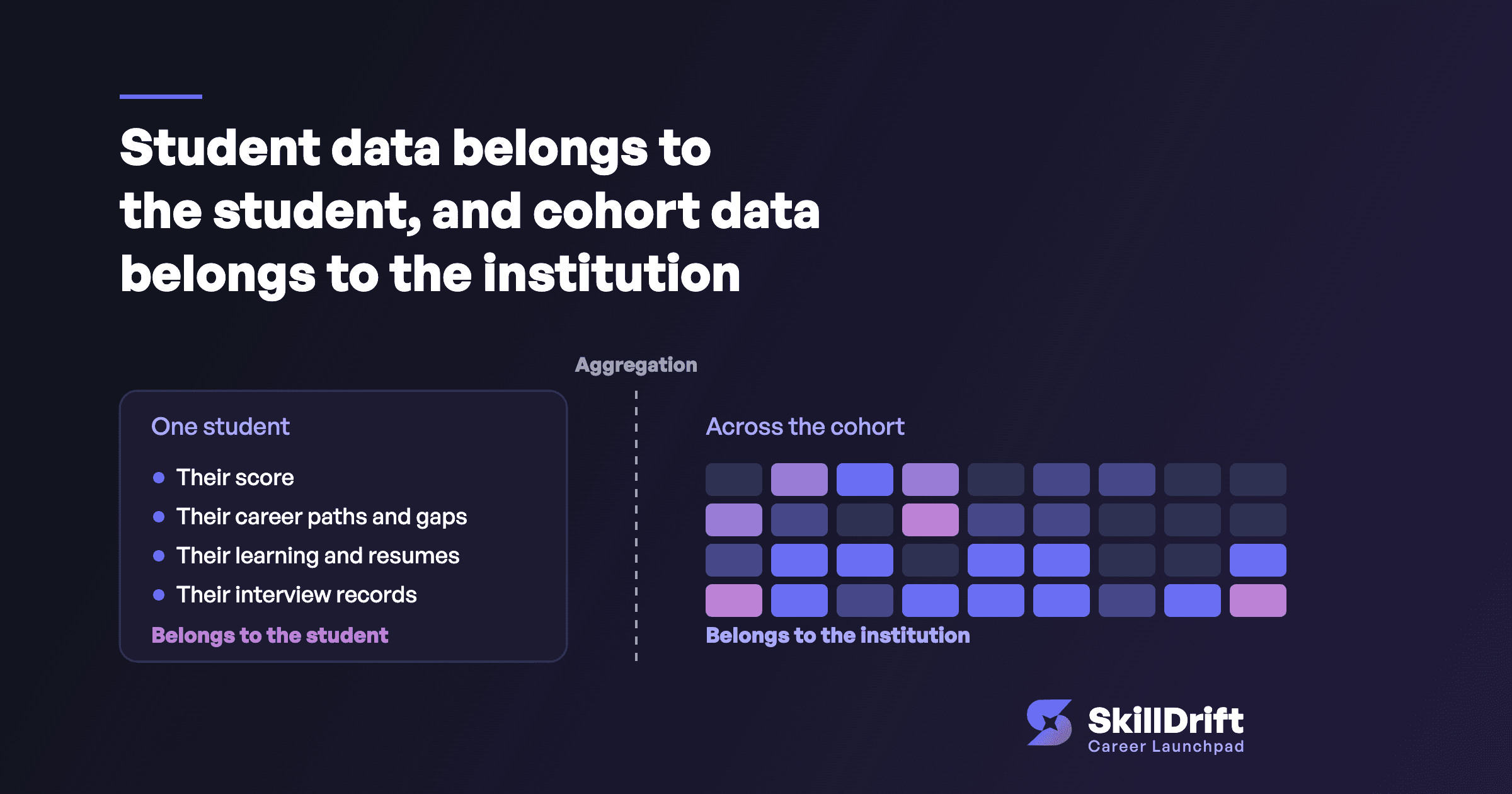
Institutional data belongs to the institution. Student learning data and profile data belong to the student. The dividing line is aggregation.
Here is what that means in practice, and what a career centre can do with it.
1. What belongs to the student?
Anything about one student belongs to that student.
That covers their Career Readiness Score and the scores behind it. It covers their career paths, their gap analysis, their learning history and the weeks they verified. It covers their resumes, their interview practice records, their profile and the documents they uploaded.
If a record describes one person, it is theirs.
2. What belongs to the institution?
Anything that only has meaning across a group of students belongs to the institution.
That covers the cohort heatmaps and the department scorecards. It covers the placement pipeline and the placement analytics. It covers the Institutional Employability Score and the comparison of each curriculum against what employers ask for. It also covers the settings the institution chose, such as its question bank and its readiness weights.
If a view only exists because many students were measured, it is the institution's.
3. Why is aggregation the line?
One score describes a person. A department average describes a programme.
The student needs the first to plan a career. The institution needs the second to run its programmes and its placement work.
Each side gets the data it acts on. Neither side has to borrow the other's.
4. What happens when a student leaves?
The student can download their own profile and take it with them.
The student starts it, it moves in one direction, and it carries their data only. Nothing institutional goes with it.
5. What happens when an agreement ends?
The institution can export its data in a standard, machine readable format for 30 days after the end date.
After that window, its personal data is deleted from live systems within 30 days. The exit terms are written into our published data protection document, so nobody has to negotiate them at the end.
6. Who can get in at all?
Access comes only from the institution. There is no public signup, and nobody can reach the institution's space from outside its list.
Students are added by the institution, by file upload or by invitation. An invited student then completes their own registration and sets their own password.
Each institution runs in its own environment, with its own database.
7. Where does employer demand data sit?
Your team sees each department's gaps beside the skills employers ask for in live job postings. That employer demand data is captured continuously across the market.
It describes what employers ask for, and it holds no student data. The comparison between your departments and that demand is a cohort view, so it belongs to the institution.
8. What can a career centre do with this?
Three things, starting this term.
- Put the question to every vendor you use: when a student graduates, whose data is it? Ask for the answer in writing.
- Tell students in their first week that their record is theirs and leaves with them.
- Bring the data protection officer in early, with the vendor's written position in hand, so the review starts from an answer.
If you would like to see how this works for your own students, write to sales@skilldrift.ai and we will set up a short call.
Questions career centre teams ask
Does SkillDrift own any of this data?
No. We hold both kinds of data so the platform can work. We own neither.
Is student data used to train AI models?
No. Direct identifiers are removed before anything is sent to a model provider. Model providers are contractually prohibited from training on what they receive.
Does AI set a student's score?
No. The Career Readiness Score is computed the same way every time, in our own system, from measured components. No language model rates the student. Cohort views are built from student responses with no model in the path.
Where is the data hosted?
Environments are hosted in Singapore unless another region is agreed in the institution's order form. Other regions are supported where an institution needs one.
Our full position, written for data protection officers and procurement teams, is on our Data Protection page. For why measurement during the course matters, read By the time you know the placement rate, you cannot change it.