A six week pilot should show a career centre whether its students became more ready
How the free Career Launchpad pilot works: 25 students, six weeks, a readiness map at week two, and a week six reassessment that shows if the number moved.
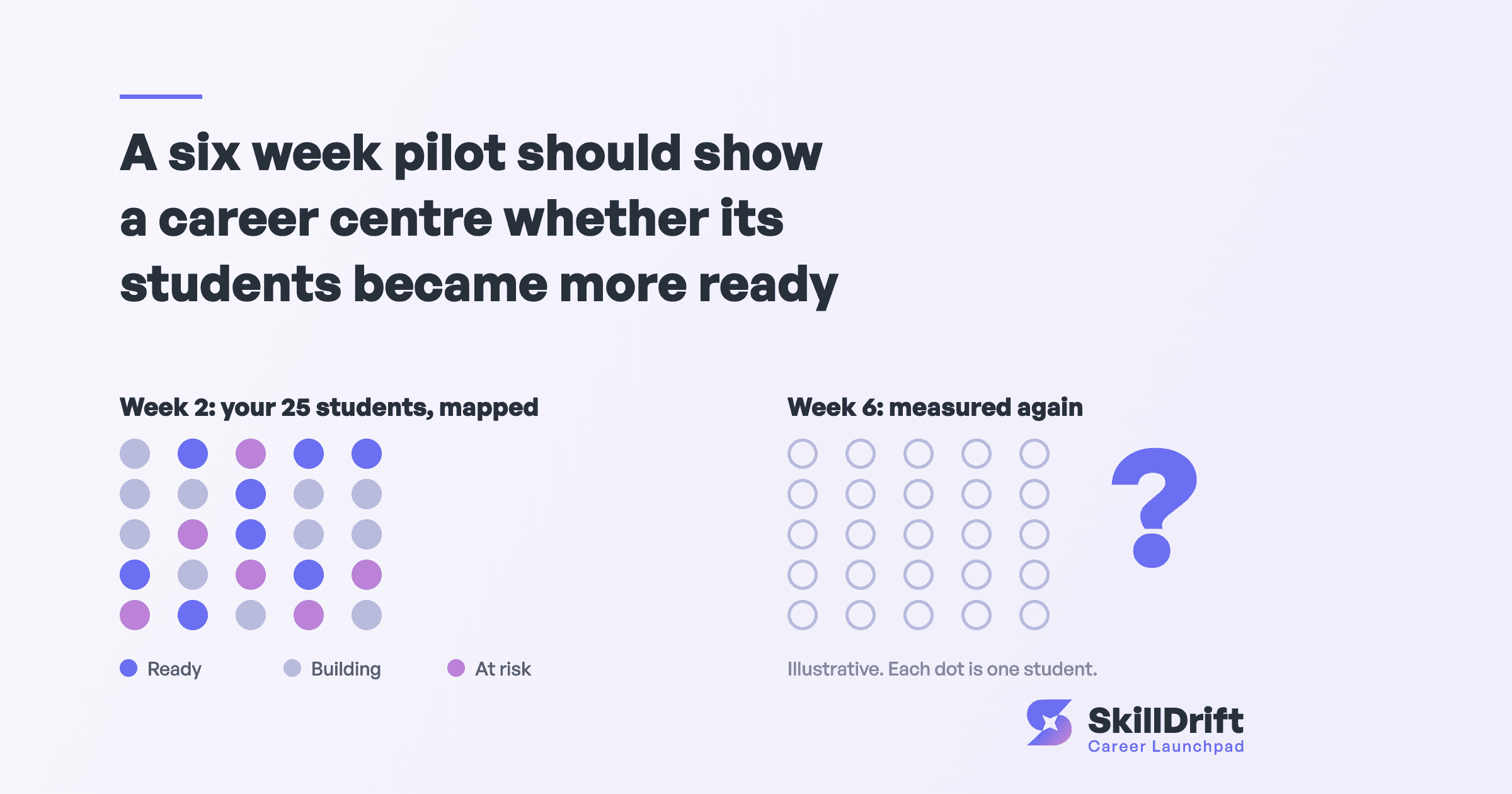
Most software pilots end with a usage report. It tells you how many students logged in. It does not tell you whether any of them became more ready for work.
A career centre needs the second answer. So our pilot is built around one question: did the number move?
Here is how it works, week by week, and what your team has at each point.
1. What is the Career Launchpad pilot?
It is free. It covers up to 25 students over six weeks. There is no purchase order and no procurement cycle before you know whether it works.
If it works, there is one price per student per year, quoted as a single flat number. You can see the terms on our pricing page.
2. Why is the pilot free?
A paid pilot needs a purchase order. In most universities, procurement is the slowest part of buying anything. Making the pilot free takes that step out until there is a result worth taking through it.
We ask for commitment instead of money. That means four things:
- A named owner on your side
- A named group of 25 students
- An agreed measure of success
- A review date in the diary
3. Which 25 students should you choose?
Choose a deliberate mix. Avoid picking only your best students.
Include some you expect to be ready, some in the middle and some you are worried about. A result across that mix tells you far more than a result from your strongest group.
4. What does your team have after two weeks?
Weeks one and two are onboarding and the first assessment. At the end of week two, you have three things:
- A readiness map for the whole group
- A breakdown by department
- A named list of students at risk
You also see each department's gaps set beside the skills employers are asking for in live job postings. That comes from the employer demand data built into the platform, which we capture continuously.
This matters because the market moves faster than a syllabus. In our October hiring pulse, communication appeared in 41 to 52 percent of entry level job postings in every market we read. The pilot shows your team where your own 25 stand on the skills that come up most in your market.
So your team has something to act on fourteen days in. The at-risk list tells you who to call first.
5. What happens in weeks three to five?
Each student gets a learning roadmap built for their own gaps and the career path they chose.
Learning only counts when the student passes a weekly knowledge check. Ticking a box does not move anything.
Students also practise interviews, with a hire verdict scored out of 10. And when an industry partner posts an opening, every student in the group is matched against it, with a job match score out of 100. Your team sees who is close to that role and what each student is missing.
6. What happens at week six?
Week six is the reassessment and the readout. The same measure runs again.
You see whether each student's readiness moved, and which parts of it moved. You also see which students did not move, and the gaps that held them back.
7. Why six weeks and not four?
The readiness score only moves on verified learning. Four weeks gives you the first diagnosis, which is useful, but it is too short to show movement.
A full semester has its own problem. It usually crosses a break, and it doubles the time before anyone can decide. Six weeks is close to the shortest time that gives you both the diagnosis and the movement.
8. What does a career centre do with the result?
If the number moved, you have evidence to take to the people who hold the budget. The readout shows which students moved and why.
If some students did not move, you know who they are and what they are missing. That is a list your team can work on straight away.
Either way, you also know where your students stand against what employers in your market are asking for. That helps with industry partners, and with the students who do not get a campus offer and need to apply more widely.
If you would like to run a pilot with your own students, write to sales@skilldrift.ai and we will set up a short call.
Questions career centre teams ask
Can a student join the pilot on their own?
No. In Career Launchpad, access comes only from the institution. There is no public signup: students are added by their institution, and an invited student completes their own registration from that invitation. A student who wants to check on their own can use SkillDrift for individuals at www.skilldrift.ai.
What happens after the pilot?
If you go ahead, the rollout takes four to six weeks: setting up departments, single sign on and the student import, an assessment window, the first readiness read and the first round of support.
For more on why this measurement matters, read By the time you know the placement rate, you cannot change it and A readiness score is only useful if it can go down.