Most fresher jobs never reach campus. Here is how to get your students to them
We read over 6,000 fresher job postings in Singapore, seven Indian cities, the UAE and the US. Most never reach a campus. Here is where students without a campus offer can go, and how your office can get them there.
Every placement season ends with students who did not get a campus offer. What they do next is often left to them.
This month we read 6,116 fresher roles posted between October 4th and 13th, in Singapore, seven Indian cities, the UAE and the United States. Most of these jobs are unlikely to reach a campus. They are where students without a campus offer can still go, and they show what those employers ask for.
1. Most fresher jobs never reach your campus
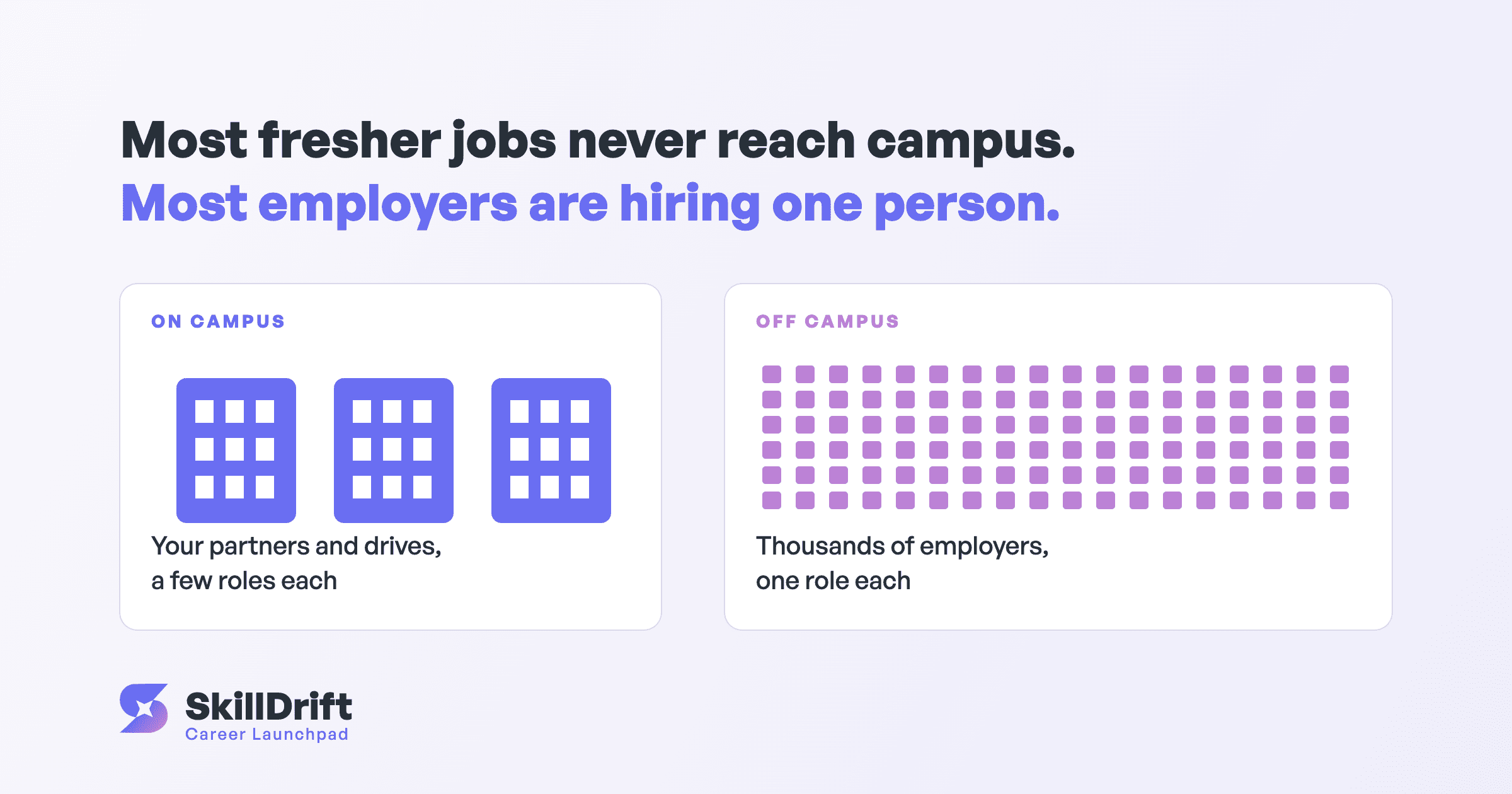
In every market we read, eight or nine in ten employers hiring fresh graduates had only one opening. In Singapore, 370 employers posted 417 fresher roles, and 332 of them had just one. In Bengaluru, 746 of 847 employers had just one. In the United States, 417 of 501 did.
The big names are there, but they hire a few at a time. In Singapore, the busiest employers, such as Mastercard, HPE and National Healthcare Group, had three openings each. In Gurugram, American Express had seven. In Hyderabad, Amgen had five and Google four.
What it means for your office: your industry partners still matter. They bring the drives, the internships and the relationships your placement record is built on. But even the largest employers hire a few freshers at a time, and nine in ten employers hiring freshers have a single opening. A campus drive reaches a small part of the market. For a student who did not get a campus offer, that is the good news: most of the market is still open to them.
What to do this semester: keep your partners, and ask more of them. Ask each partner to share every fresher opening they have through the year, including single roles that would never justify a drive. Then stay with the students who have no offer after the season ends. For each city they want, find the single openings that fit each student and send them there, every week.
2. Communication is asked for everywhere. The second skill depends on the city
About half of all fresher postings ask for communication in some form: 50 percent in Singapore, 52 percent in New Delhi and Gurugram, 43 percent in Bengaluru and 52 percent in US degree roles. That share has not moved since June. No other skill comes close in every market.
The technical skills change with the city:
- In Bengaluru and Pune, Python, SQL, JavaScript and Git sit near the top.
- In Mumbai, New Delhi and Gurugram, customer service sits near the top.
- In Singapore, it is Python.
- In US degree roles, it is Python and analytical skills.
- In the UAE, the fresher roles we saw were mostly in hospitality, schools and site safety, so the skills were food preparation, lesson planning and hazard identification.
What it means for your office: communication is the one skill your students need wherever they go. The second skill depends on where they want to work, and your placement records already tell you where that is.
What to do this semester: give every final year student one piece of evidence of communication they can point to in an interview, such as a presentation, a written report or a client project. Then match your technical training to the cities your students actually move to.
3. Python, SQL and AI are rising
Our jobs index started collecting at the end of May and has grown since, so we compare shares of fresher postings in June and July against September and October. We do not compare raw counts.
- Across the seven Indian cities, Python went from 9 to 13 percent of fresher postings, SQL from 7 to 10 percent and AI skills from 6 to 9 percent. That rests on more than 24,000 postings. Singapore points the same way, on a much smaller base.
- AI is still a small ask. In no market did it appear in more than one in ten fresher postings.
What it means for your office: the skills employers are adding to fresher roles are data and code. AI is growing, but for a first job, Python and SQL are the bigger and nearer gain.
What to do this semester: check this semester's training calendar. Add a Python and SQL track for students heading to Indian cities and Singapore, and keep AI as a short add-on to it.
4. Teach students to read the experience line
In Singapore, two in three entry roles did not say how much experience they wanted. US degree roles were the same. In the Indian cities, a little over half did say.
When a role does state experience, about one in five asks a fresh graduate for two years or more: 18 percent in Singapore, and 19 percent in Bengaluru, Pune and US degree roles. The UAE was very different: 19 of the 30 roles that stated experience asked for two years or more. We also read the duties in each posting. Our reading matched what the employer wrote more than nine times in ten, so a two year ask usually means it.
What it means for your office: a student who treats a missing experience line as a warning skips roles that are open to them. A student who applies to roles asking for two years or more is unlikely to be shortlisted.
What to do this semester: teach one simple rule in your placement workshops. No experience line means apply. Two years or more means move on. For students heading to the UAE, expect most roles that state experience to want it.
5. International students need to ask about visas early
Almost no posting says whether it sponsors a work visa. In Singapore, 25 of 417 mentioned it, and 21 of those said no. In US degree roles, 107 mentioned it, and 95 said no.
Internships made up about a quarter of fresher roles in Singapore (104 of 417) and Bengaluru (257 of 993), and about one in seven in Mumbai and Gurugram. We saw none in the UAE in this window.
In the US, about one in three degree roles posted a pay range. The middle of those ranges was about US$82,500 a year, and half sat between US$70,000 and US$103,500. Pay is rarely shown in Singapore and India.
What it means for your office: your international students cannot tell from a posting whether they can take the job. In Singapore and Bengaluru, internships are a large share of the way in.
What to do this semester: add the visa question to interview preparation for international students, so they ask it before the first interview. In Singapore and Bengaluru, push students to apply for internships, since they are a quarter of the entry market there. For students heading to the US, use the pay range above to set expectations before offers arrive.
City by city, October 4th to 13th
For each market: fresher roles, internships, employers, employers with one opening, share asking for communication, share stating experience, and of those, share asking for two years or more.
- Singapore: 417 roles, 104 internships, 370 employers, 332 with one opening. 50% ask for communication. 35% state experience, and 18% of those ask for two years or more.
- Bengaluru: 993 roles, 257 internships, 847 employers, 746 with one opening. 43% ask for communication. 57% state experience, and 19% of those ask for two years or more.
- Mumbai: 741 roles, 107 internships, 655 employers, 595 with one opening. 47% ask for communication. 56% state experience, and 16% of those ask for two years or more.
- New Delhi: 738 roles, 139 internships, 658 employers, 598 with one opening. 52% ask for communication. 56% state experience, and 12% of those ask for two years or more.
- Hyderabad: 726 roles, 150 internships, 625 employers, 560 with one opening. 47% ask for communication. 54% state experience, and 16% of those ask for two years or more.
- Pune: 703 roles, 160 internships, 622 employers, 556 with one opening. 47% ask for communication. 62% state experience, and 19% of those ask for two years or more.
- Chennai: 638 roles, 120 internships, 557 employers, 507 with one opening. 45% ask for communication. 63% state experience, and 12% of those ask for two years or more.
- Gurugram: 450 roles, 61 internships, 409 employers, 379 with one opening. 52% ask for communication. 54% state experience, and 10% of those ask for two years or more.
- UAE: 68 roles, 0 internships, 61 employers, 56 with one opening. 41% ask for communication. 44% state experience, and 63% of those ask for two years or more.
- United States (degree roles): 642 roles, 61 internships, 501 employers, 417 with one opening. 52% ask for communication. 33% state experience, and 19% of those ask for two years or more.
Seeing this for your own students
Everything above describes the market. Your office also needs the same view of your own students: who is not yet placed, which openings each of them fits, which skills each department is missing, and which students are at risk while there is still time to act.
Career Launchpad gives you that view. It scores each student against live openings out of 100. Your industry partners can post their openings straight into it, and each partner role is matched against every student too. It sets each department's skill gaps against what employers ask for, and it keeps the at risk list current without anyone on your team entering data.
How we counted
The numbers come from the SkillDrift jobs index, read on October 14th, 2026.
We counted postings seen between October 4th and October 13th that SkillDrift reads as intern or junior level. We removed recruitment agencies, job boards, training providers, "confidential" employers and senior titles. A role posted more than once was counted once. In the United States, we counted only roles that ask for a degree, because many US entry roles are hourly retail jobs. That gives 6,116 fresher roles across ten markets.
"Seen in the last ten days" is a lower bound. Some roles are filled through referrals or campus visits and never appear online.
The UK had too few fresher postings in this window to report on its own. Malaysia and Australia are not yet in the index.
If you would like to see this for one of your departments, write to sales@skilldrift.ai and we will set up a 25 minute call.
This is the first monthly graduate hiring pulse. The next one comes out in November. Our series on why careers work is measured too late is on the blog.