A readiness score is only useful if it can go down
Most readiness numbers only go up, so they never warn a career centre in time. Here are three things a useful readiness score has to do.
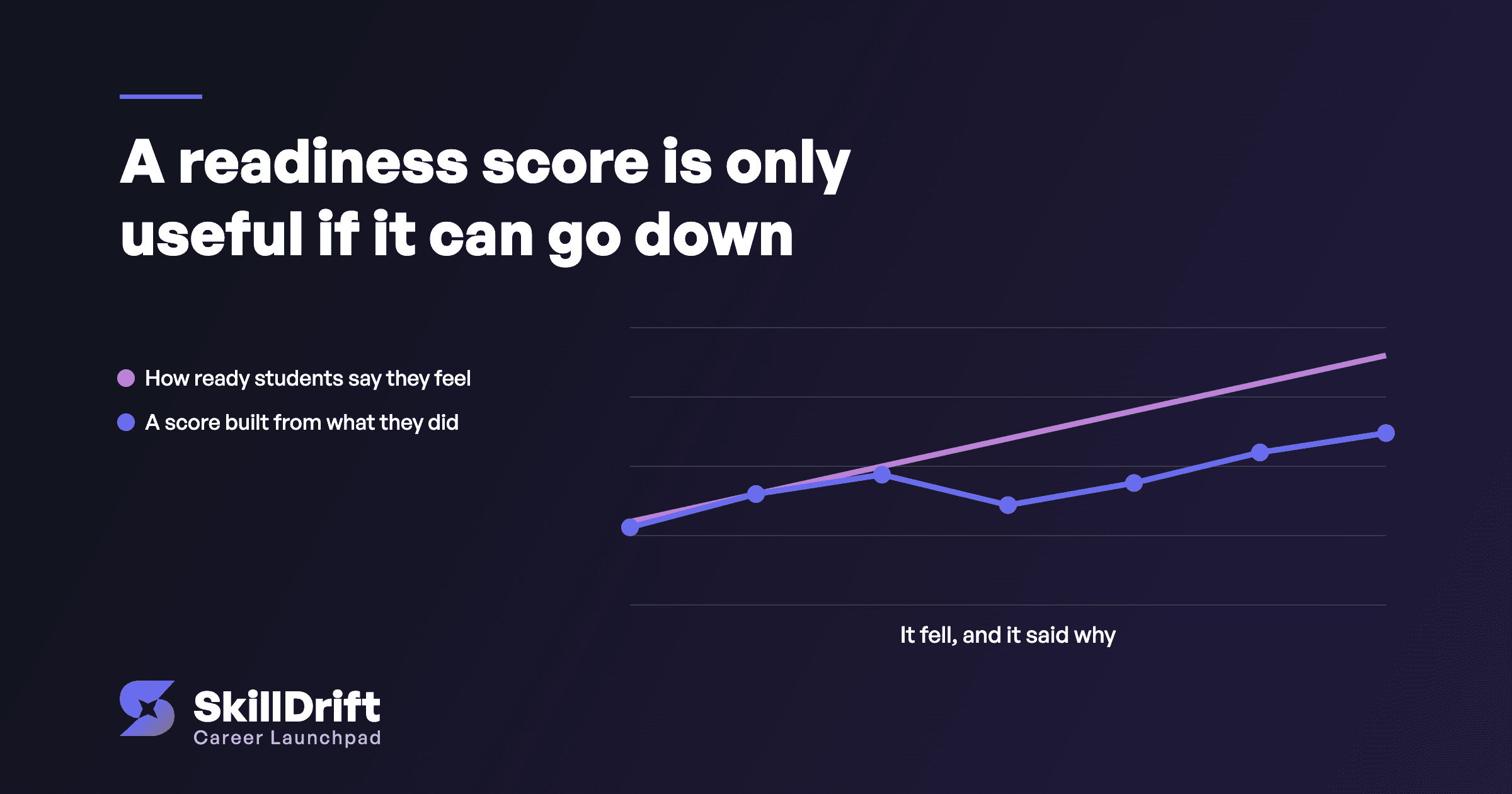
Most career centres now track some kind of readiness number. It might be a self rating, a checklist, or points for attending workshops.
Here is a simple test. Has that number ever gone down for a student?
For most centres, the answer is no. The number only goes up. That is pleasant to report. It cannot tell you who needs help.
1. Why most readiness numbers only go up
A common pattern looks like this. A student rates themselves at the start of the year. They attend workshops, fix their CV and do a mock interview. At the end, they rate themselves again. The number goes up.
It goes up for almost everyone. The reason is confidence. Students feel more ready once they have heard the same advice many times. Feeling ready and being able to do the work are different things.
Employers see the difference. In January 2025, NACE in the United States asked graduating students and employers the same question. 78.1 percent of the students rated their own communication as proficient. Only 53.5 percent of employers agreed.
A number built on how students feel will keep rising. So will a number built on attendance. Neither can drop, so neither can warn you.
2. Three things a useful readiness number has to do
It gives the same answer twice
Measure the same student on the same work twice, and you should get the same number. If two staff members score the same student differently, the number is an opinion.
What it means for your team: you can compare students across programmes and across the year, and trust the comparison.
It can fall
Students can lose ground. They might pick a harder target role. The jobs they want might start asking for new skills. A good number shows that.
What it means for your team: a falling number is an early warning. It points you to the student while there is still time to help.
It explains every change
When a number moves, someone will ask why. The student will ask, your team will ask, and so will leadership. The answer should name the part that moved and by how much.
What it means for your team: a change you can explain is a change you can act on. "Down three points, because your new target role asks for SQL" tells a student exactly what to do next.
3. The hard conversation, and how to make it easier
A number that can fall will sometimes fall in front of a student. That can feel discouraging, for them and for you.
Two things help. First, explain at the start what the number measures: the distance between the student and the job they want. If they aim higher, the distance grows, and the number drops. That is the number doing its job.
Second, never show the number alone. Show the reason next to it, and one thing to do next.
4. What this changes for a career centre
With a number that can fall, your team can:
- Spot the students who are slipping, as well as those who never started
- Show leadership real movement, up and down, with the reason for each change
- Tell industry partners which students are ready for which roles, with evidence behind it
- Help a student who missed a campus offer see exactly what to work on before the next one
Try this with your team
Take the readiness measure you use today and ask three questions.
- Has it ever gone down for any student?
- If you measured the same student twice, would you get the same number?
- When it changes, can you say why in one sentence?
If any answer is no, the number will not warn you in time.
If you would like to talk it through for your own students, write to sales@skilldrift.ai and we will set up a short call.
How we built ours
We built the readiness score in SkillDrift Career Launchpad on these three rules. It is a number out of 100, made from nine measured parts, such as a skill assessment, scenarios and evidence of experience. The same work always gives the same score. The score can go down. And every change comes with the part that moved it.
Questions career centre teams ask
Won't a falling score put students off?
It can, if it arrives with no explanation. Set the expectation at the start, and always show the reason and the next step beside the number.
Can a self rating be part of a readiness number?
Yes, as one input. It should sit beside evidence of what the student can actually do: work they produced, scenarios they answered, experience they can show.
How often should readiness be measured?
Often enough to catch a slide while there is time to act. At the least, at the start of the programme and again before placement season.
This is the fourth post in our series on why careers work is measured too late, and what to measure instead. Read the first three: By the time you know the placement rate, you cannot change it, Two conversations that never meet and Your career centre serves more people than the placement rate counts. The full series is on the blog.