Two conversations that never meet
Students cannot say what they are short of, and placement heads cannot say who is at risk. Why the two conversations never meet, and what would join them.
There are two conversations about employability going on inside most institutions, and they rarely meet.
The first happens with the student. Ask a second year student three plain questions. What are you short of for the role you want? Which role fits what you can do today? What should you do on Tuesday evening that would move you closer? Most students cannot answer any of them with confidence. They have plenty of advice. They have sat through a workshop on interviews, read a list of skills that employers want and been told to build a portfolio. Very little of it tells them where they personally stand, or what to do first.
The second happens in the placement office, often with leadership in the room. How many of this year's cohort are employable? Which fifteen students are most at risk, while there is still time to help them? The head of placements can usually answer with last year's figures and a well informed sense of this year's group. A sense is hard to defend in a meeting, and it is harder still to plan a year around.
Both conversations are honest, and both are about the same students. They never connect, because each side describes those students in its own terms.
The same students, described twice
Look at what each side has to work with.
The student describes themself in their own words. Their sense of their skills comes from coursework, from feedback on assignments and from comparison with friends on the same course. It is sincere, and it has nothing outside the course to check it against.
The institution describes the same student in records. It holds grades, attendance, the number of sessions booked with the career centre and, at the end, the placement outcome. These are accurate, and they say very little about whether this student could do the work a particular employer will ask for.
Neither description is wrong. They are in different units, so they cannot be added up, compared or reconciled. A student cannot look at an attendance record and learn what to do next. A head of placements cannot add up three hundred students' views of themselves and get a cohort figure that anyone would sign off.
When both sides are asked the same question
There is one published case where both sides were asked about the same thing, and the answers show how far apart they sit.
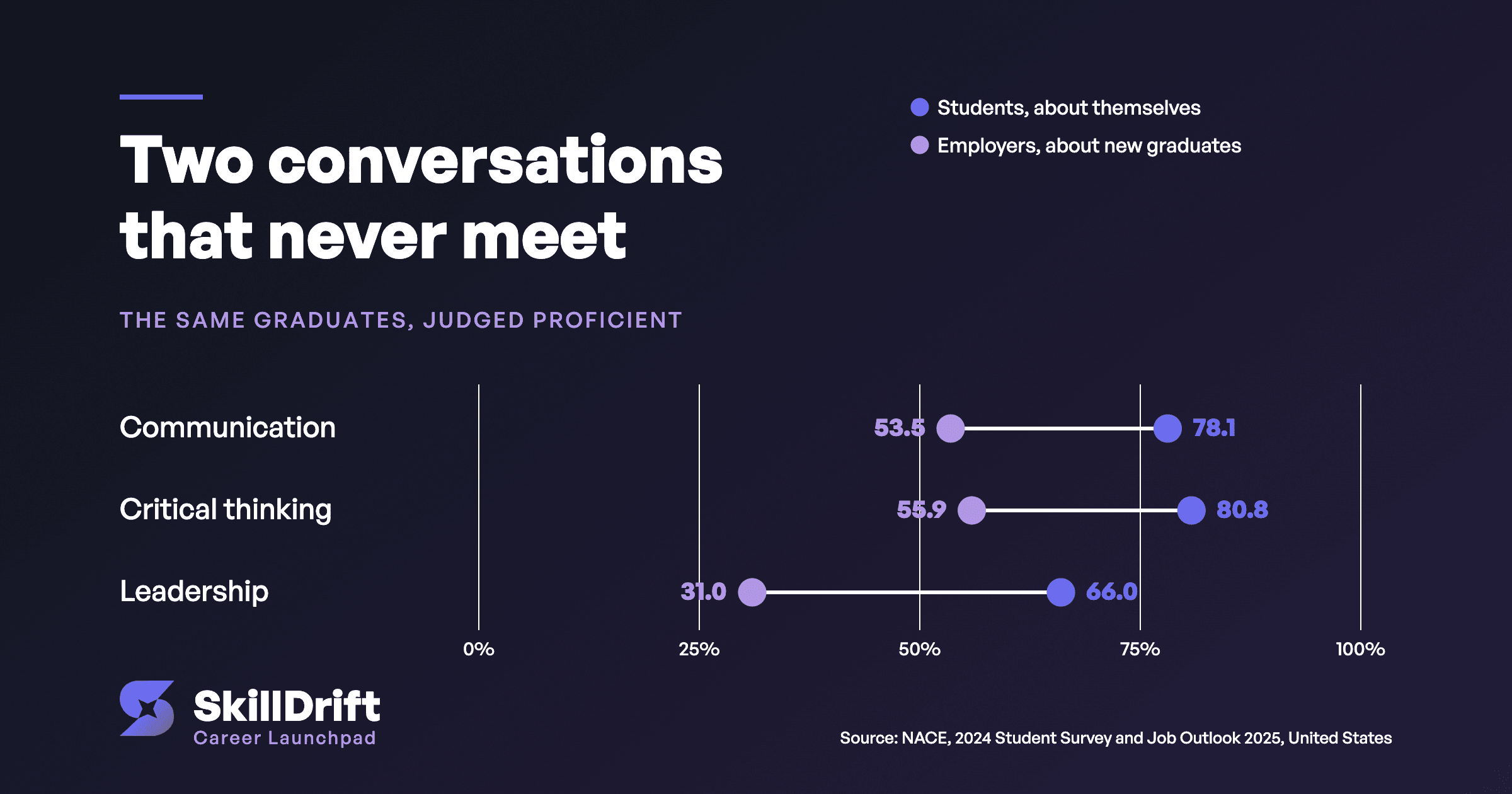
In January 2025, NACE in the United States put two of its surveys side by side. Its 2024 Student Survey asked graduating seniors how proficient they were in a set of career competencies. Its Job Outlook 2025 survey asked employers how proficient they found new graduates in the same competencies. In communication, 78.1 percent of students rated themselves proficient, against 53.5 percent of employers. In critical thinking the figures were 80.8 and 55.9 percent. In leadership they were 66.0 and 31.0 percent.
Neither group is careless. Each one answers from what it can see. The student sees their own coursework and effort. The employer sees the first months in a job. They judge the same graduates on different evidence, so they reach different answers, about twenty five points apart on communication and thirty five on leadership.
Inside an institution the same thing happens on a smaller scale, and nobody puts the two views side by side. The student's picture of themself and the institution's picture of the student sit in different places and are never compared.
Why more conversation does not close it
The usual response is to bring the two sides closer, through more counselling, more mentoring, a careers module or a bigger team. Each of these helps the students it reaches. None of them changes the units.
A counsellor who spends an hour with a student comes away with a good picture of that student. That picture lives in a note or in the counsellor's memory. It does not add up to a cohort figure, and it cannot be compared with the picture another counsellor holds of another student. When leadership asks how many are ready, the team still has to estimate.
It runs the other way too. When the institution reports that a programme placed a certain share of its students, that figure tells a current student nothing about their own position. A report built from outcomes cannot be turned back into advice for one person.
So the two conversations stay apart however hard both sides work. The effort is real, and the units stay different.
What a shared unit would have to do
If the student's question and the institution's question are going to meet, both have to be answered from the same evidence, in the same unit.
For the student, that unit has to point at something specific: this role, this gap, this next step. A number with no reason attached gives a student nothing to do on a Tuesday evening.
For the institution, the same unit has to add up. The cohort figure has to be built from the students' figures, so that it can be opened up to the programme, the group and the student behind it. Then "how many are employable" and "which fifteen are most at risk" become two views of one set of readings.
Both sides also have to trust that it reflects the student's actual work. That means it has to be measured against what employers ask for, outside the classroom, so that the student, the institution and the employer would recognise the same person in it.
When all of that holds, a student who closes a gap moves the institution's figure, and the head of placements can see which piece of work moved it. The student's question and the institution's question become two readings of the same thing.
The next posts in this series look at what such a measure has to survive before anyone should act on it.
A question to put to your own team
Take one student from this year's cohort whom you know well. Write down, in a sentence, where that student stands and what they should do next. Then look at what your institution would report about the same student.
If the two sentences use different words and different evidence, you have found the gap this post is about. Most teams find that they do.
If you would like to work through it against your own cohort, write to sales@skilldrift.ai and we will set up a short call.
Questions career centre teams ask
Why not ask students to rate themselves and add up the answers?
Self ratings describe how confident students feel. The NACE figures show that this confidence often runs well ahead of what employers see, so a total built from self ratings would overstate readiness, and it could not tell you which students to help first.
Is this the same problem as the placement rate arriving too late?
The two are related. The placement rate is a question of timing. This one is a question of units, because even early information about a student cannot be compared with the institution's figures unless both are measured the same way.
Does closing the gap need a bigger careers team?
A bigger team reaches more students. It still has no way to add up what it learns about each one, so the cohort question stays unanswered.
This is the second piece in a series on why careers work is measured too late, and what to measure instead. It follows By the time you know the placement rate, you cannot change it, and the rest of the series is on the blog.