Your career centre serves more people than the placement rate counts
Exam takers, working adults and students in careers courses now use the career centre too. The placement rate was never built to count them.
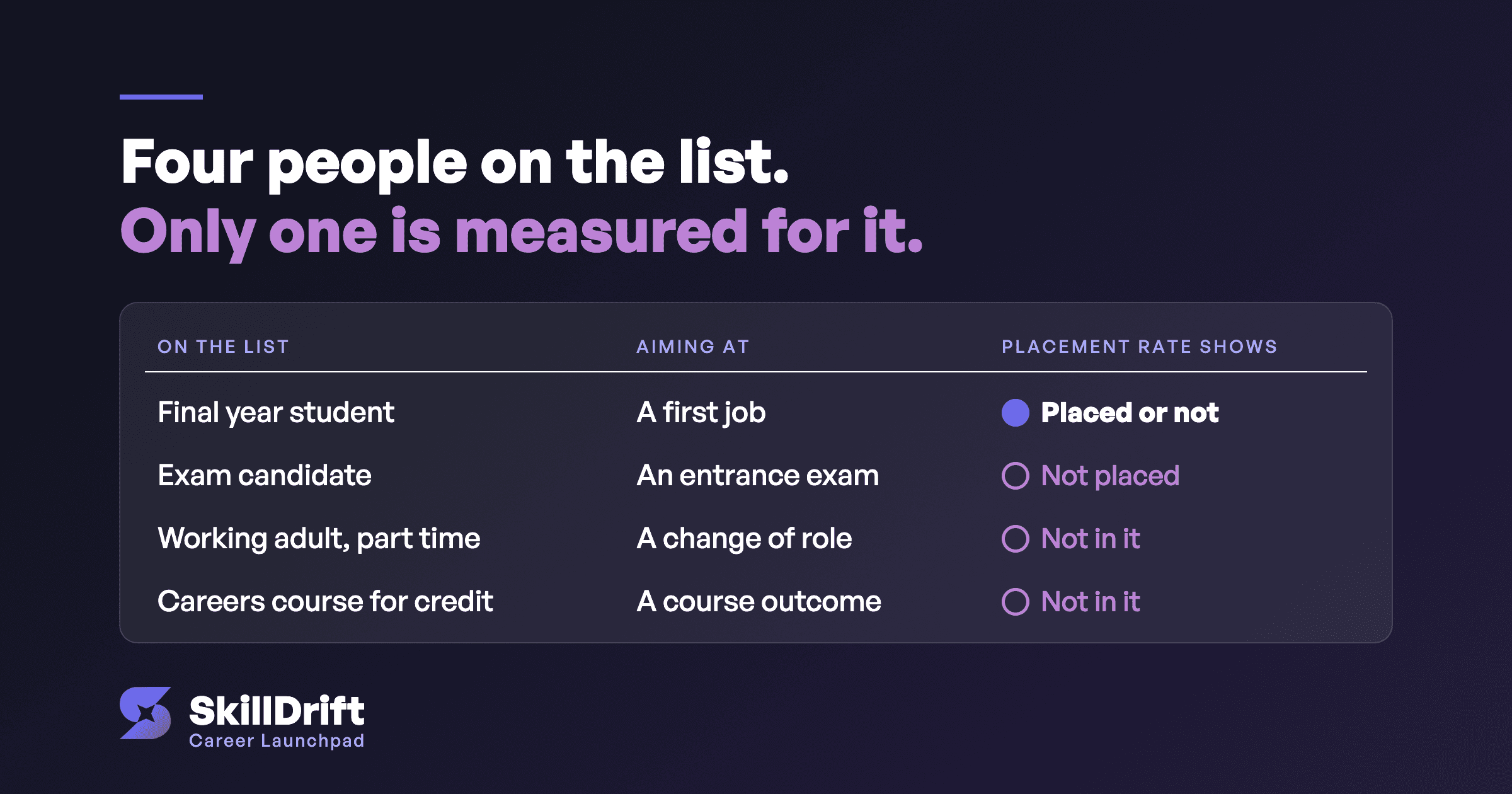
Think about the student a placement rate was built for. They are about 21. They study full time. They finish their degree in June, and then they look for their first job.
The placement rate counts this student. The graduate survey follows up with them. Campus hiring season is planned around them.
That student still comes to the career centre. But today they share it with at least three other kinds of people. The placement rate was never built to count any of them.
1. The student preparing for an exam
Some students are not looking for a job yet. They want to clear an exam first.
It could be a medical entrance test, a banking exam or a civil service exam. It could be a professional qualification in accounting or law. The job comes after the exam.
The placement rate marks this student as "not placed", even when they are well prepared. If they are not prepared, the career centre only finds out when the results come out. By then it is too late to help.
The career centre needs to know the same two things it needs for every student. Where does this person stand today? What should they work on next? Only the target is different. For this student, the target is the exam syllabus.
2. The working adult on a short course
Many people who study today already have a job.
In Singapore, 606,000 people took training supported by SkillsFuture Singapore in 2025. The year before, the number was 555,000. In the United States, about four in ten part time undergraduates were 25 or older in fall 2021. That figure comes from the National Center for Education Statistics.
These learners do not belong to a graduating class. They join in the middle of their careers. They take a course for a few weeks or a few months, and then they leave.
The question for their institution is simple. Did this person move closer to the role they wanted? Can the institution show it?
Today that answer usually comes late. In February 2026, SkillsFuture Singapore reported on 15,000 people who finished its Career Transition Programme between June 2022 and June 2025. Within six months, 51 percent of them had found new roles or employment.
That is a useful number for a national programme. But it is counted after the course ends. It cannot tell a course team which learner is falling behind while the course is still running.
3. The student in a careers course for credit
Some universities now teach career preparation as a regular course. It has a syllabus, a teacher, assignments and credits. Every student in the programme takes it, including students who would never visit the career centre on their own.
This changes who is asking the question. Now it is a faculty member with sixty students. They need to know where each student stands in week one. They also need to know how far each student moved by the end of the course.
A grade shows that a student came to class and did the work. It does not show whether the student is any closer to a job than they were in week one.
What the three have in common
The career centre now serves more kinds of people. The way it measures them has not changed.
The placement rate, the graduate survey and the appointment log were all built for the full time student who graduates in June. They tell you nothing useful about an exam candidate. They arrive too late for a twelve week course. They cannot tell a teacher how the class is doing.
Yet every one of these people raises the same question. Where does this person stand against their goal, and are they getting closer? Only the goal changes. It could be a first job, an exam, a new role at forty or the result of a course taken for credit.
A measure that only knows about first jobs leaves most of these people out. It counts some of them as failures. A better measure starts with the goal each person actually has.
Try this with your team
Take a sheet of paper and make three columns.
In the first column, list every group your career service works with. In the second, write what each group is aiming for. In the third, write what you could show your leadership about that group today.
If the third column is empty for everyone except final year students, you have found the gap.
If you would like to talk it through for your own groups, write to sales@skilldrift.ai and we will set up a short call.
Questions career centre teams ask
Should students preparing for an exam count in the placement rate?
Most placement rates mark them as not placed. That says nothing about how ready they are. It is more useful to track them on their own, against what their exam asks for, while they are still preparing.
How do you measure career readiness for adult learners on short courses?
Check where each learner stands at the start of the course. Check again at the end, against the role they want. A six month outcome number is still useful for the programme. It just arrives after the learner has left.
How do you assess a careers course taken for credit?
Grade the work as you would in any course. Then add one more check: where each student stood against a real role in week one, and where they stand at the end.
This is the third post in our series on why careers work is measured too late, and what to measure instead. Read the first two: By the time you know the placement rate, you cannot change it and Two conversations that never meet. The full series is on the blog.