When a student gets more ready, the career centre's number should move with it
When a student gets more ready, the career centre's number should move with it. How the loop works, what moves the number, and what to do this term.
Most institutions keep two sets of numbers about the same students.
Students see grades and feedback, and near the end, an offer or no offer. The career centre sees a placement rate, months after the year has closed.
The two rarely move together. A student can improve all term, and nothing on the career centre's desk changes until the survey comes back.
The fix is one measure that both sides share, and that moves when the student moves.
1. Why do students and career centres use different numbers?
They are measured by different people, at different times, for different reasons.
A lecturer marks what was taught. A career adviser sees the students who book a meeting. The placement office counts offers at the end.
Each of these is useful. They are also in different units, so they cannot be added up or compared.
2. What does "the same number" mean?
It means the number a student sees about themselves is the number the institution's view is built from.
In SkillDrift Career Launchpad, that number is the Career Readiness Score. It is out of 100 and built from nine measured components. A student sees their own score and the reason for each change. A department's view is averaged from the same scores.
Our own site puts it in one line: "Every step a student takes shows up on the institution's dashboards automatically: the same numbers, at two altitudes." Nobody fills in a form to keep the other side current.
3. How does a student's progress reach the institution?
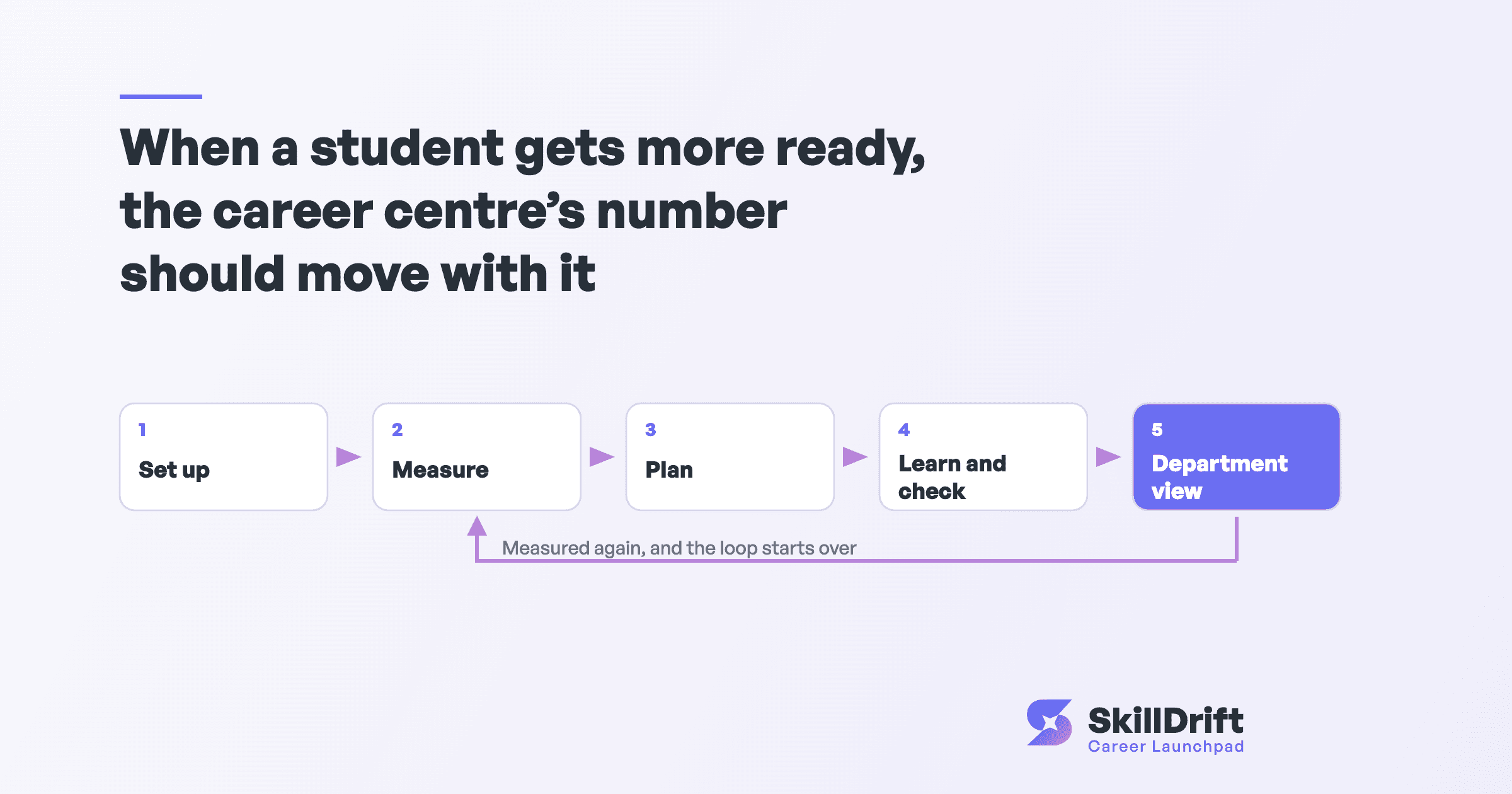
Five steps, and then they repeat.
- The institution sets the frame: its departments, its grading scale and the length of each programme.
- Each student is measured in one sitting of 20 to 30 minutes, and gets a report.
- The student picks a target role and gets a plan for the gaps between them and that role.
- Each week of learning ends with a knowledge check. Passing it can move the score.
- The department view moves with the students in it, and staff act where it shows a problem.
Then the student is measured again, and the loop starts over.
4. What moves the number, and what does not?
Reading a lesson does not move it. Passing the knowledge check at the end of the week does. The institution's own course material counts the same way, once it carries the same check.
The rise from learning is capped. A student cannot learn their way across the readiness line from below. Crossing it takes a fresh measurement.
The number can also fall. A student who fails a retest in an area they were credited for loses that credit.
This is what makes a shared number safe to act on. If it could only rise, nobody on either side would trust it.
5. What does the career centre see when students move?
Three things, all built from the same scores.
- Department averages for readiness and for each of the eight capability dimensions. Clicking a cell on the heatmap names the students behind it.
- A placement pipeline in which three of the five stages update themselves from readiness. Staff move students only into Interviewing and Placed.
- A list of students at risk, by name, while there is still time to act.
None of it needs a member of staff to type anything in.
6. Where does the market come in?
A student's target does not stand still. Employers change what they ask for.
In the entry level postings we read in late October, communication was named in 42 percent in Singapore, 44 percent in the UAE and 46 percent in the UK. Between August 30th and October 4th, SQL rose from 10.5 to 13.0 percent of the postings we index.
So the loop has a second input. Each student's jobs are scored out of 100 against their own profile, from live openings, so the plan stays tied to what employers ask for now. The institution sees the same market by department, through the employer demand pulse.
7. What can a career centre do this term?
Four things, starting this term.
- Choose one measure that students and staff will both see. If students cannot see it, they cannot act on it.
- Measure one whole cohort the same way, including the students who never come to the office.
- Count learning only when it is checked.
- Measure again before the placement season, and look at what moved.
If you would like to see the loop on your own students, write to sales@skilldrift.ai and we will set up a short call.
Questions career centre teams ask
Do students see the same score as staff?
Students see their own score journey and the reason for each change. Staff see the full component breakdown and the department averages. The number underneath is the same.
Can the number go down?
Yes. A failed retest in an area a student was credited for takes that credit back. A score that can only rise is a score nobody should trust.
Does our own course material count?
Yes, once it carries the knowledge check. A week counts when its check is passed, whoever wrote the material.
Does this replace our placement rate?
No. The placement rate stays the outcome you report. The shared number is what you can act on before it.
This is the last post in our series, The measurement problem. For where it started, read By the time you know the placement rate, you cannot change it. For why the number must be able to fall, read A readiness score is only useful if it can go down.