How to measure graduate employability before students graduate
How a career centre can measure graduate employability while students are still enrolled, starting from what employers in its own market ask for now.
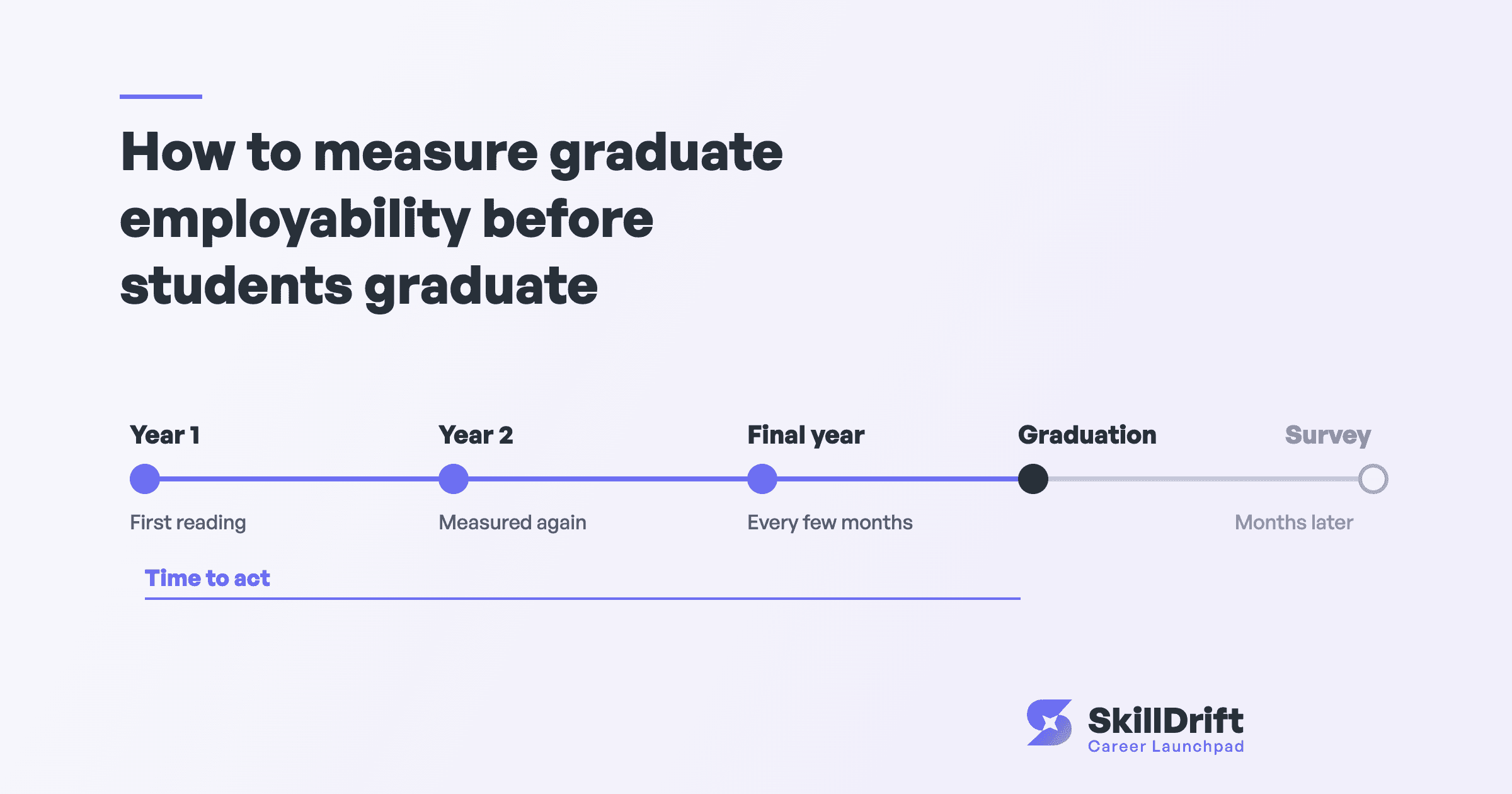
Most measures of graduate employability arrive after students have left. A survey reaches graduates months later, and the result is published later still. We wrote about that delay in What the Graduate Outcomes survey measures, and why it arrives too late to act on.
This page is about the other half. How can a career centre measure employability while students are still enrolled, and act on it in time?
1. What does graduate employability mean?
Graduate employability is how ready a student is to get work in the field they are aiming for, and to do that work well.
That definition has two parts you can measure. The first is the market: what employers in your region ask of new graduates right now. The second is the student: what each student can show against that list today.
Employability is the distance between the two.
2. Start from what employers in your market ask for
A measure built only on the syllabus cannot show that distance. So start with live job postings for graduates, in your own market.
Here is what we saw in entry level and internship postings over the ten days to October 27th. Each market is counted on its own.
- Singapore: 1,664 postings from 770 employers
- United Arab Emirates: 187 postings from 107 employers
- United Kingdom: 200 postings from 131 employers
Three findings stand out.
Many entry level postings ask for experience
In Singapore, 21 percent of these postings asked for at least a year of experience. In the UAE it was 30 percent. In the UK it was 9 percent.
What your office can do: count internships, projects and part time work as evidence from the first year. A student who leaves with none of it is shut out of one in five entry level roles in Singapore before they apply.
Communication is asked for nearly everywhere
Communication appeared in 42 percent of the Singapore postings, 44 percent in the UAE and 46 percent in the UK.
What your office can do: make sure every final year student has something to show for it, such as a presentation, a written report or a client project.
AI skills depend heavily on the market
AI skills appeared in 13 percent of the Singapore postings, 8 percent in the UK and 2 percent in the UAE.
What your office can do: read your own market before adding AI training to every programme. The answer differs by country, and often by department.
3. Measure every enrolled student
A survey hears from the graduates who reply. A measure taken during the course can include every enrolled student.
That matters, because a survey cannot name the students who did not reply. When every student is measured, the at-risk list includes all of them by name.
4. Measure what a student can show
A student's own rating of their confidence is easy to collect. It is also a weak signal, because employers hire on what a student can do.
A stronger measure looks at evidence. That means a skill assessment, how the student handles work scenarios, how they communicate, and the experience they can actually point to.
5. Measure early, then measure again
One reading in the final term comes too late to change much.
Take the first reading early in the course, so every student has a baseline. Then measure again as the course goes on, more often in the final year. Your team can then see which students are moving and which are not.
6. Turn the measure into work for your team
A measure is only useful if it changes what the office does this term. Four uses matter most:
- Call the students at risk first, while there is time to help
- Show each department its widest gaps against the market, so faculty know what to strengthen
- Send each industry partner the students who fit their openings
- Keep working with students who miss the campus offer, because most openings never come through a campus drive
How Career Launchpad measures it
In SkillDrift Career Launchpad, each student has a Career Readiness Score out of 100. It is built from nine measured components: skill assessment, experience and evidence, scenarios, career alignment, voice, academic record, written reflections, supporting documents and engagement quality.
Your team sees each department's gaps set beside the skills employers ask for in live postings. That employer demand data is captured continuously, so it reflects your market as it is now.
When an industry partner posts an opening, every student is matched against it with a job match score out of 100. Students can also practise interviews and get a hire verdict scored out of 10.
If you would like to see this for your own students, write to sales@skilldrift.ai and we will set up a short call.
Questions career centre teams ask
What is the difference between graduate employability and graduate outcomes?
Graduate outcomes describe what graduates did after they left, such as work or further study. Graduate employability describes how ready a student is before they leave. You can act on the second while the student is still enrolled.
Can employability be measured in the first year?
Yes. A first year reading gives each student a baseline. It is less useful as a prediction than as a starting point, because later readings show who is moving.
What data does a career centre need to start?
Two things. Current job postings for graduates in your own market, and a measure that every student takes. Course data and partner openings can be added later.
How is this different from a placement rate?
A placement rate counts students after the season ends. We explained why that arrives too late in By the time you know the placement rate, you cannot change it.
How we counted: SkillDrift jobs index, read October 28th, 2026. Postings labelled entry level or internship and seen between October 18th and 27th, each market counted separately. Experience means the employer stated at least one year. AI skills means a skill naming AI, generative AI, machine learning, large language models or named AI tools.