What the Graduate Outcomes survey measures, and why it arrives too late to act on
Graduate Outcomes surveys graduates about 15 months after they finish, and the results arrive later still. What it measures, and what to add to it.
If you work in a career service in the UK or Australia, the Graduate Outcomes survey is probably one of the numbers your institution is judged on. It is a careful national measurement. It also describes students who left a year or more before anyone can read the result.
What the UK Graduate Outcomes survey measures
Graduate Outcomes is run by HESA. It surveys graduates about 15 months after they finish their course and asks what they are doing: work, further study or something else, with the details of any job.
It also asks graduates whether they agree with three statements. My current activity is meaningful. My current activity fits with my future plans. I am using what I learnt during my studies in my current activity.
The latest results cover students who graduated in 2023/24. They were surveyed between December 2nd, 2024 and November 30th, 2025, and the results were published on June 4th, 2026. 353,755 graduates responded, and 87 percent of them were in work or further study.
What the Australian Graduate Outcomes Survey measures
In Australia, the Graduate Outcomes Survey is part of QILT, the Quality Indicators for Learning and Teaching. Graduates are asked to take it about four to six months after they finish. It covers employment, further study, salaries, occupations, whether graduates use their skills in their work, and how satisfied they were with their course. It runs in three rounds a year, in November, February and May. A longitudinal survey asks the same graduates again about three years later.
The 2025 national report covers graduates who completed the survey between November 2024 and May 2025, with more than 129,000 valid responses. It was published in June 2026.
When the number arrives
Put those dates against one student.
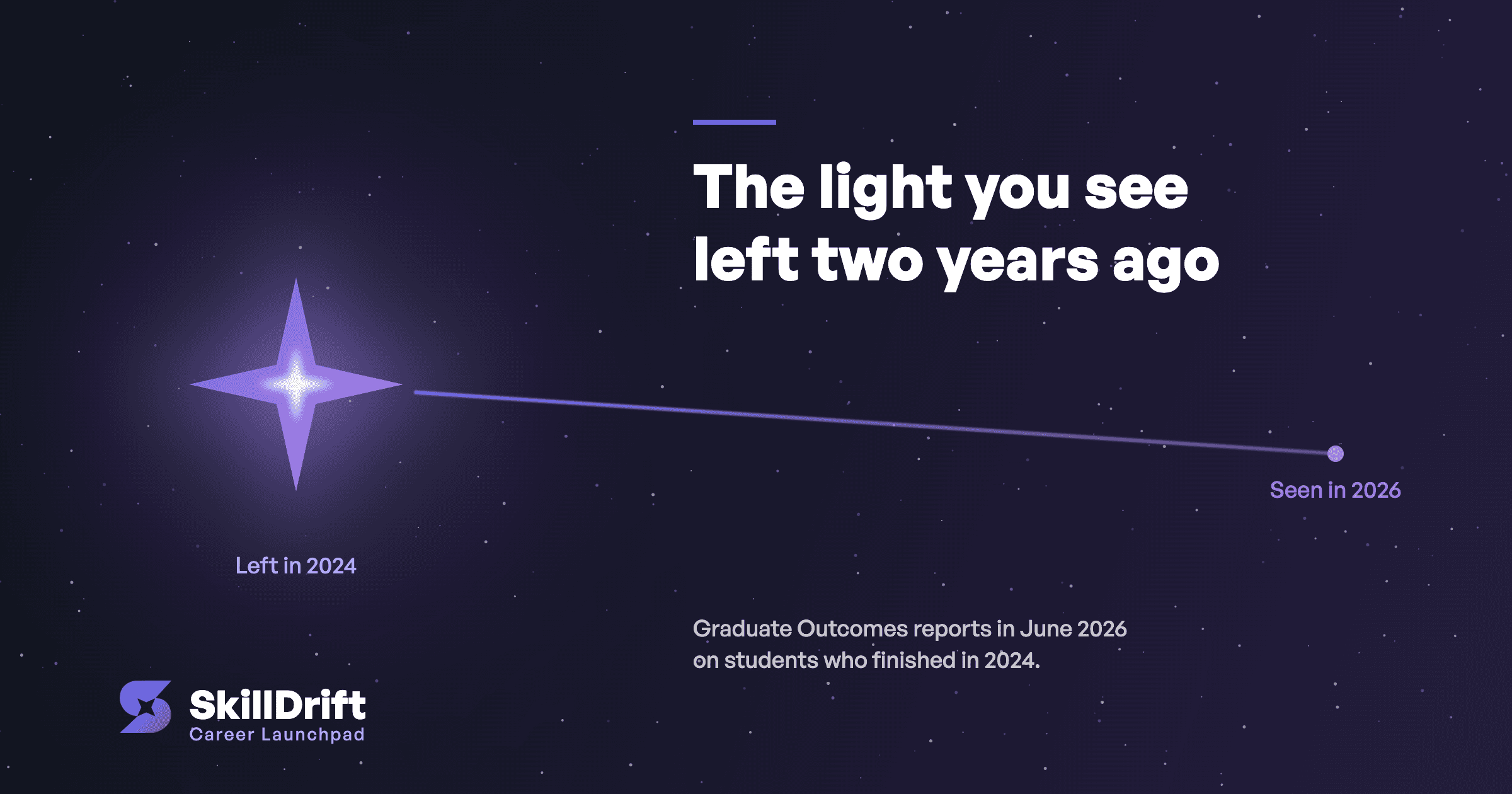
In the UK, a student who started a three year degree in September 2021 finished in the summer of 2024. They were surveyed around the autumn of 2025, and the national figure that includes them was published in June 2026. That is about two years after they left and close to five years after they arrived.
The Australian survey reaches graduates sooner. Even so, the national report on graduates who answered between November 2024 and May 2025 appeared in June 2026, more than a year after the last of them replied.
By the time either figure is public, the students it describes have left, and the next two or three cohorts are well into their courses.
What the survey is good for
It does what it was built to do. It gives a consistent national picture, collected the same way at every institution, so courses and institutions can be compared fairly. League tables and course guides use it, governments use it to shape policy, and institutions use it to review courses and careers support. The three reflection statements add the graduate's own view of whether the work means something, which a job title alone cannot show.
Any careers team should read it closely.
What it cannot do
It cannot tell you which of your current students need help.
The survey describes people who have already gone. When a figure falls, it tells you that something went wrong for a cohort some years ago. It does not tell you which students were affected, which skills were missing or in which year it started. By then the students who could have been helped are in jobs, in further study or looking for work somewhere else.
We made the same point about the placement rate in By the time you know the placement rate, you cannot change it. Graduate Outcomes is the national version of the same problem, with a longer delay.
What to measure alongside it
Keep the survey and read it every year. Add a reading taken while students are still enrolled, for every student, repeated as the course goes on.
That reading has to describe where each student stands now, against the roles they are aiming for, in a form that adds up to a cohort figure. It also has to be able to fall when a student drifts, so the team sees the problem while there is time to act.
On SkillDrift Career Launchpad, that reading is the Career Readiness Score: a number out of 100 for each student, computed from nine measured components. It can go down as well as up, and every change is logged with a plain reason. It is reassessed roughly once a year in first year and about every three months in the final year.
Read the survey to learn how a cohort did after it left. Read the measure taken during the course to decide which students to work with this term.
If you would like to see what that looks like for your own cohort, write to sales@skilldrift.ai and we will set up a short call.
Questions about Graduate Outcomes
When is the Graduate Outcomes survey sent?
In the UK, about 15 months after a graduate finishes their course. In Australia, the Graduate Outcomes Survey goes out about four to six months after completion.
When are Graduate Outcomes results published?
The UK results for students who graduated in 2023/24 were published on June 4th, 2026. The Australian national report for the 2025 survey was published in June 2026.
What does the Graduate Outcomes survey ask?
What the graduate is doing, such as work or further study, with the details of any job. The UK survey also asks whether the graduate's current activity is meaningful, fits their future plans and uses what they learnt.
Can a university use Graduate Outcomes to help its current students?
Only indirectly. The survey describes graduates who have already left, so it can shape the next review of a course. To decide which current students to help, a careers team needs a measure taken while those students are still enrolled.
This page is part of a series on why careers work is measured too late, and what to measure instead. The rest of the series is on the blog.