Career readiness competencies: how a career centre can measure them across a whole cohort
The eight NACE career readiness competencies, what a cohort wide measure needs, and how SkillDrift's eight dimensions line up with them.
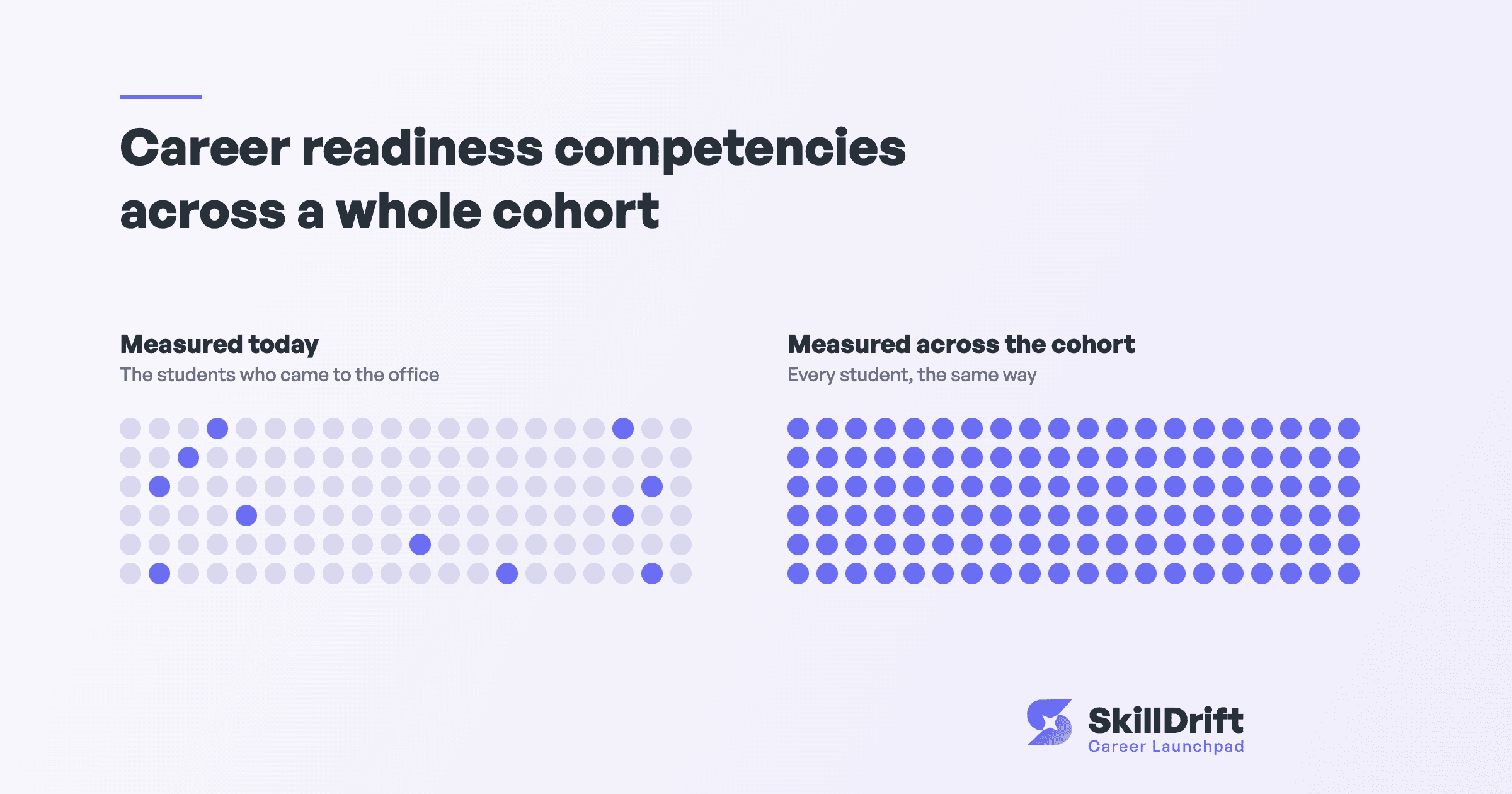
Most career centres already know the NACE career readiness competencies. Many use them in workshops, in advising and in reflections after an internship.
The harder question is measurement. How does a career centre know where every student stands, including the students who never book an appointment?
This page sets out the competencies as NACE publishes them today, what a measure across a whole cohort needs, and how SkillDrift's own numbers relate to the NACE list.
1. What are the NACE career readiness competencies?
NACE is the National Association of Colleges and Employers in the United States. It describes career readiness as a foundation of core competencies that prepare graduates for success at work and for managing their careers over a lifetime.
On its website, read on November 11th 2026, NACE lists eight competencies:
- Career and self-development
- Communication
- Critical thinking
- Equity and inclusion
- Leadership
- Professionalism
- Teamwork
- Technology
Each competency has a short definition and a list of sample behaviours. NACE also notes two things a career centre should know. The equity and inclusion competency is currently under review, and NACE says it will post updates. The eight are also meant to be flexible: an institution can use them in any combination, and there is no requirement to use all eight.
2. Why is a competency list hard to measure across a cohort?
A competency framework says what students should develop. It does not say how to measure every student against it.
In most offices, measurement happens through the students who come forward. A student books an appointment, attends a workshop or writes a reflection after an internship. Each of these produces evidence for one student at one point in time.
The students who never come in produce no evidence at all. So a career centre can know a great deal about its most engaged students and very little about the rest of the cohort.
Self ratings are the usual shortcut. They are easy to collect at scale, but they move easily. A confident student and an accurate student can give the same answer.
3. What does a measure across a whole cohort need?
Four things.
- The same instrument for every student, so results can be compared across departments.
- Evidence beyond a self rating, such as situational scenarios, project and internship evidence, and how a student speaks.
- Results by department as well as by student, so the office can see where to spend its time.
- A second measurement, so the office can see whether students moved.
It also helps to know which of these things employers in your market ask for most often.
4. Which competencies do employers name in job postings?
Employers rarely write the word competency in a posting. They do name some of the same things.
We read entry level postings in our jobs index, junior roles and internships, seen between October 18th and 28th. Communication was named in 42 percent of 1,664 Singapore postings, 44 percent of 187 UAE postings and 46 percent of 200 UK postings.
AI skills, one part of technology, were named much less often in the same postings: 13 percent in Singapore, 2 percent in the UAE and 8 percent in the UK.
So about two in five entry level postings ask for communication in all three markets. The ask for AI skills differs a great deal from one market to the next. We set out more of these figures in How to measure graduate employability before students graduate.
5. How do SkillDrift's dimensions line up with the NACE competencies?
SkillDrift Career Launchpad has its own measure. Most of it lines up with the NACE list, and one part does not.
The Career Readiness Score is one number out of 100. It is built from nine weighted components: skill assessment, experience and evidence, scenarios, career alignment, voice, academic record, written reflections, supporting documents and engagement quality.
Underneath the score sit eight capability dimensions, each scored 1 to 5. They are cognitive and analytical ability, communication and interpersonal, digital and technical readiness, execution and accountability, initiative and ownership, learning agility and adaptability, career orientation and interests, and resilience and professional maturity.
The dimensions are what a student is measured on. The components are what the score is built from. One component, skill assessment, draws on six of the dimensions.
The dimensions are the part to set beside the NACE list. We read the NACE definitions beside our own. Five of the eight competencies line up closely with a SkillDrift dimension, two are covered in part, and one is not measured.
- Career and self-development: D7 career orientation and interests, and D6 learning agility and adaptability.
- Communication: D2 communication and interpersonal.
- Critical thinking: D1 cognitive and analytical ability.
- Equity and inclusion: no SkillDrift dimension measures this.
- Leadership: in part, through D5 initiative and ownership.
- Professionalism: D4 execution and accountability, and D8 resilience and professional maturity.
- Teamwork: in part, through D2, which covers working with and through people.
- Technology: D3 digital and technical readiness.
This is our own reading of the two sets of published definitions. NACE has not reviewed it, and the dimensions were not built from the NACE list, so the match is close and not exact. A career centre that reports against NACE can use the dimension results as evidence for the competencies they cover. It needs its own evidence for equity and inclusion, and for most of teamwork and leadership.
What Career Launchpad gives a career centre is the cohort measure described in section 3. Every student takes the same assessment, in one sitting of 20 to 30 minutes. A component with no data scores zero, so a student cannot reach a high score by skipping the hard parts. Cohort heatmaps show the eight dimensions for each cohort, and clicking a cell names the students behind it. Students are measured again as their course goes on, and the score can go down as well as up.
6. What can a career centre do this term?
Four things, starting this term.
- Choose the competencies your institution will use. NACE allows any combination.
- For each one, write down what evidence would show it, beyond a student's own rating.
- Measure one whole cohort the same way, including the students who have not come to the office.
- Report the results by department, and measure again before the placement season.
If you would like to see a whole cohort measured, write to sales@skilldrift.ai and we will set up a short call.
Questions career centre teams ask
Does SkillDrift score students on the NACE competencies?
Not directly. Five of the eight line up closely with SkillDrift's capability dimensions: career and self-development, communication, critical thinking, professionalism and technology. Leadership and teamwork are covered in part, and equity and inclusion is not measured. The Career Readiness Score itself is built from nine components, and it is not a NACE score.
Why are there nine components and eight dimensions?
They answer different questions. The eight dimensions describe what a student can do. The nine components are the inputs to one score, and they include evidence such as internships, academic record and supporting documents as well as the assessment itself.
Do we have to use all eight NACE competencies?
No. NACE says the competencies can be used in any combination. It also says the equity and inclusion competency is under review.
Can a readiness score replace a competency framework?
No. A framework tells students and staff what to develop. A score tells the office where each student stands now. Most career centres will want both.
For why measurement has to happen before graduation, read By the time you know the placement rate, you cannot change it. For what a high score does and does not tell you, read A score of 85 means a student is ready only if three things are true.