A career readiness assessment and a job readiness score answer different questions
A career readiness assessment, a job readiness score and an employability skills assessment answer different questions. Here is what each measures, and what to ask.
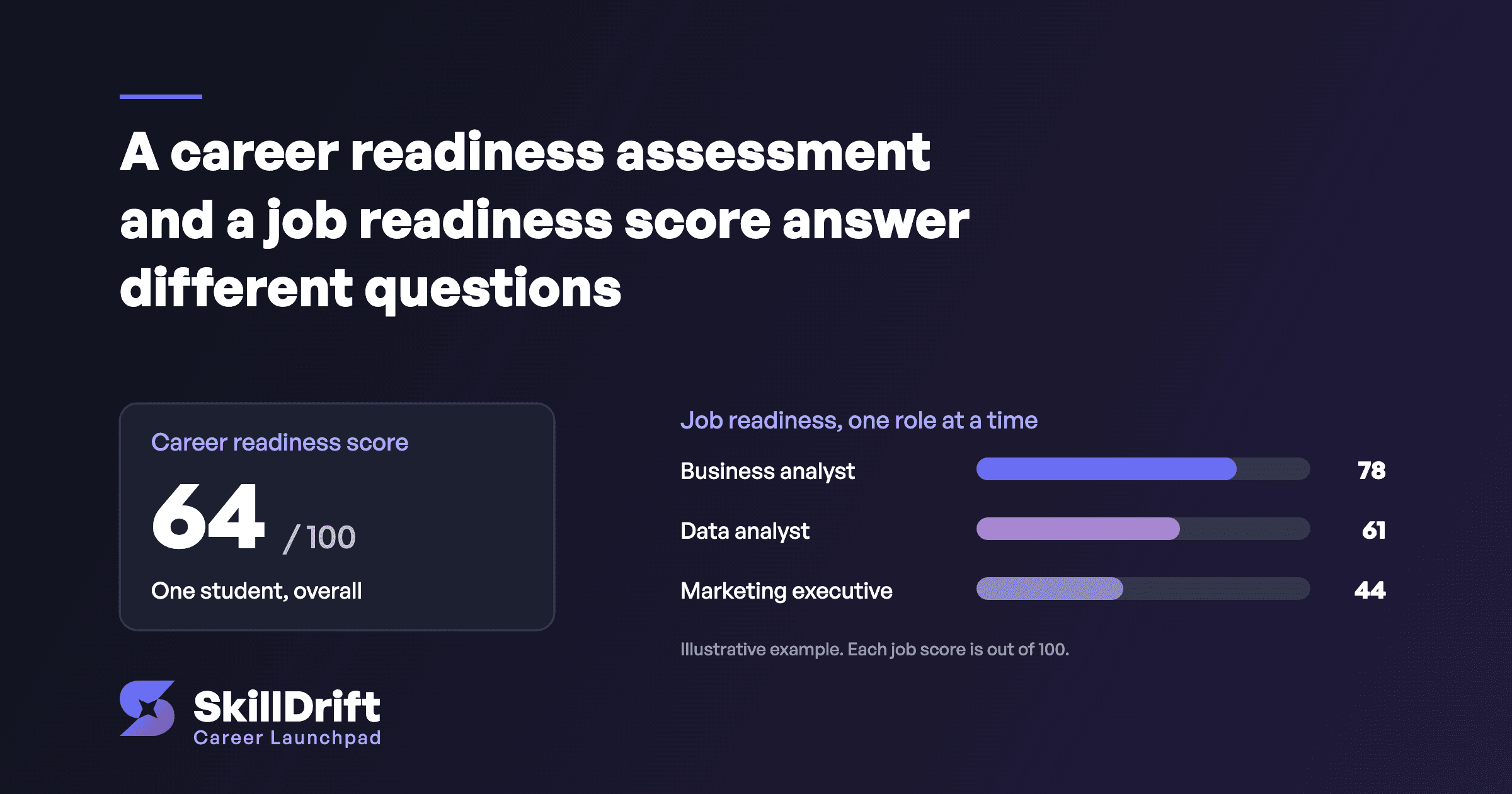
Career centres hear three terms all the time: career readiness assessment, job readiness score and employability skills assessment.
They are often used as if they mean the same thing. They answer three different questions.
Here is what each one is, how they fit together, and four questions to ask before you trust any of them.
1. What is a career readiness assessment?
A career readiness assessment is the measurement itself. A student takes it, and the result shows where they stand.
A useful one looks at what the student can do. That covers their skills, how they handle work situations, how they communicate and what experience they can show.
The result is a career readiness score. It answers one question: how ready is this student overall?
2. What is a job readiness score?
A job readiness score answers a narrower question. How ready is this student for one particular job?
It compares the student with what one job posting asks for. The same student can be close to one role and far from another.
So a job readiness score only means something when you know which job it was scored against. When you see one, ask which job it is for.
3. What is an employability skills assessment?
An employability skills assessment usually tests the skills most employers ask for, whatever the role. Communication, teamwork and problem solving are the usual ones.
These skills matter a great deal. In our October hiring pulse, about half of all fresher job postings asked for communication. It was 50 percent in Singapore, 52 percent in US degree roles and between 41 and 52 percent in every other market we read.
A common skills test still cannot tell you whether a student is ready for the role they want. The rest of each posting asks for things that belong to that role.
4. How the three fit together
The assessment is how you measure. The career readiness score is the overall result. The job readiness score is that result held against one role.
A career centre needs all three:
- The assessment, to see where each student stands
- The overall score, to compare students across a whole cohort
- The job score, to send the right students to the right openings
5. Four questions to ask about any readiness measure
- Ready for which role? If the tool cannot name the role, it is measuring something general.
- Is it the same measure for every programme? If each department uses its own test, you cannot compare across the cohort.
- Which number is this? Overall readiness and fit for one job are different numbers. Every report should label which one it shows.
- Does the student get a next step? A score is far more useful when it comes with one thing the student can do next.
If a measure fails the first or the third question, its numbers are hard to act on.
How Career Launchpad keeps the numbers apart
In SkillDrift Career Launchpad, the Career Readiness Score is out of 100. It is built from nine measured components, such as a skill assessment, scenarios, voice and evidence of experience. You can see every component on the Career Readiness Score page.
Job match is a separate score, also out of 100. It scores one student against one role. When an industry partner posts an opening, every student is matched against it.
The two are never averaged into one number.
If you would like to see this for your own students, write to sales@skilldrift.ai and we will set up a short call.
Questions career centre teams ask
Is a job readiness score the same as a career readiness score?
No, they are different. A career readiness score describes one student overall. A job readiness score describes one student against one job.
Can a student take a career readiness assessment on their own?
In Career Launchpad, students are set up by their institution, so there is no sign up page. A student who wants to check on their own can use SkillDrift for individuals at www.skilldrift.ai.
How does SAML and LMS integration work with Career Launchpad?
Students and staff sign in through the university's own login, using SAML 2.0 or OIDC. The course catalogue is fetched from the institution's LMS, or from any other source with an API.
For more on how careers work can be measured earlier, read By the time you know the placement rate, you cannot change it and A readiness score is only useful if it can go down.